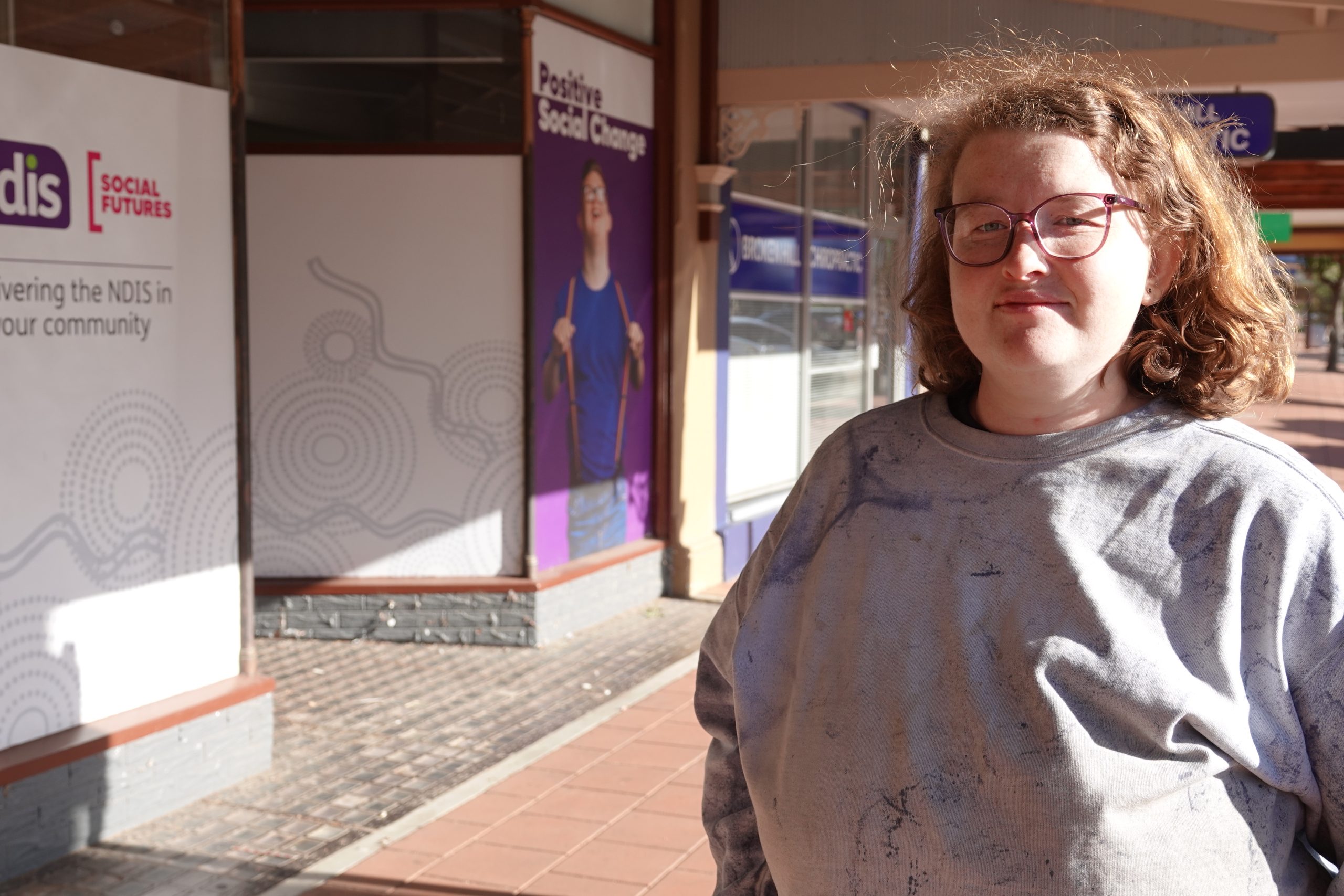
Charlotte, in Broken Hill NSW, has Cerebral Palsy and values her independence. With support from Social Futures and the NDIS, she has been able to access help at home, connect with health services, and work towards her goals of living independently, finding work, and finishing her first novel. Her story shows how the right support can help people with disability live more independently and pursue the life they choose.
Charlotte has Cerebral Palsy that affects the right side of her body. “I’m a lot weaker on my right side than I am on my left,” she explains, “It’s affected me in different ways.”
For someone who is fiercely independent, accepting support can be almost as challenging as trying to survive without it.
30-year-old Charlotte Panton has always done things her own way. Living in Broken Hill with her two dogs, she’s quietly creative and has ambitious goals.
Now, with the right support, she’s shaping the life she wants, but on her own terms.
Relying on her left-hand means everyday tasks take extra thought and effort. Cooking is one example.
“I can’t cut things up very well,” she says. Carrying things is another. “I don’t trust my right hand to carry, say, a cup of tea. I really only trust it for carrying bags, and I make sure I don’t have anything breakable in them.”
But Charlotte is a problem-solver and has learnt to improvise. One of her creative outlets is making paracord bracelets, a task most people need both hands to do, along with a jig to weave the cord, but Charlotte has found a different way.
“I have to sticky tape it down to something that acts like a bench for me and use the bench itself to hold the paracord in place,” she says.
Prior to joining the NDIS and engaging Social Futures, an NDIS partner in the community, Charlotte says day-to-day life was hard for her.
“I’ve always been an independent person. I rarely liked asking for help.”
In fact, for Charlotte, asking for help went sorely against the grain.
“Most of the time, I’d get pretty cross if someone tried to help without asking me,” she says. “I basically relied solely on myself to get things done.”
For a time, her partner helped with tasks, but when that relationship ended, Charlotte realised she found it difficult on her own. “It’s been hard… to need to ask for help again has been really rough,” she adds.
Living with Cerebral Palsy affects Charlotte’s balance, muscle tone and motor control. It makes everyday tasks, like dressing, cooking or cleaning, difficult.
When a friend suggested Charlotte talk to someone about the NDIS it was a step in the right direction, but gathering all the necessary medical reports as evidence to meet NDIS eligibility did prove more challenging than she first thought.
This is where Sherean, a Social Futures local area coordinator, made a real difference.
“Sherean was able to help me get my NDIS plan put through. It took me a couple of tries because I needed to get my records from all over the place. But once I had them, she was able to help set my NDIS goals and then get my plan all sorted.
“I still stay in contact with Sherean,” Charlotte says. “She checks on me every couple of months. If I have any changes or need anything, I just let her know.”
Charlotte now has support to help her manage household tasks and her garden, enabling her to live as independently as possible. She also has support to connect with her community.
Charlotte says, “Thursdays are the big days”. A support worker comes in to help her clean her home and to do the jobs she can’t do.
‘They always say, before they leave, ‘If you need anything, just give me a buzz and we’ll come and help,'” Charlotte says. “Which has been very helpful.”
NDIS funding has also opened doors to health supports Charlotte says she hasn’t been able to access prior to joining the Scheme.
“I wouldn’t be able to go see the physio without NDIS help,” she says. Funding for other therapies, like OT (Occupational Therapist) has also helped.
Charlotte says she has three main goals in her NDIS plan – living independently, finding work, and finishing her novel.
She’s already ticked off the first goal and says employment is the next, high on her list. When asked what her dream job would be, Charlotte says, “I really wanted to work with animals when I was a kid, so I still really want to work with animals if I can one day.”
In the meanwhile, Charlotte, a keen potter, is thinking about turning her hobby into a small business, which could help her generate some income. She credits pottery for also helping to build her confidence, in particular her social skills.
“I can see myself doing pottery and paracording in future… perhaps selling my work through a stall at craft fairs,” she says.
Charlotte is also an aspiring author. She’s writing a book – a fantasy romance with “adventure on the side, and a bit of thrill” but admits trying to make a complete world from scratch isn’t easy. However, she’s found inspiration in J.R.R. Tolkien, who sketched his story landscapes before writing them.
It’s a passion project, but one Charlotte’s determined to return to.
Although reluctant to accept help, Charlotte says over time her view has shifted.
Charlotte’s also grateful for all the advice and support she’s had and continues to have from all the dedicated staff looking to support her to successfully move forward with her life.
“The people at Social Futures are really nice, and they really do try to be understanding as much as they can,” she says. “They go that extra mile for you when you need information. I really appreciate that.”
Call 1800 522 679, Monday – Friday, 8:30 am – 4:30pm, or email [email protected]