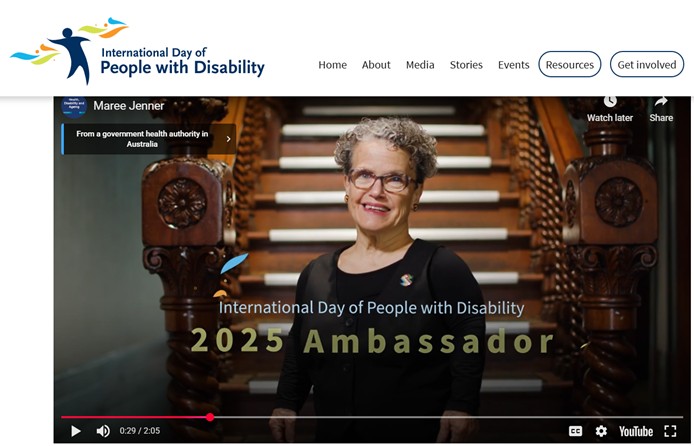
National Ambassador for International Day of People with Disability (IDPWD), Maree Jenner, talks about what this role means to her, the power of education, and her vision for a truly inclusive future.
Social Futures is incredibly proud to celebrate our own Maree Jenner, who has been selected as a National Ambassador for International Day of People with Disability (IDPWD). This honour is recognition of Maree’s deep commitment to breaking down barriers for people with disability.
We sat down with Maree, our Gosford-based Community Engagement LAC, to discuss what this role means to her, the power of education, and her vision for a truly inclusive future.
For Maree, who is short statured, the path to becoming an IDPwD Ambassador began with visibility. An avid gardener, Maree was watching the ABC’s Gardening Australia show when they referred to a plant with the cultivar name which included the word ‘midget’ – a word deeply offensive to many people living with dwarfism. Not one to let an opportunity to educate pass her by, Maree wrote to Gardening Australia to alert them to this and to ask if the plants could be referred to as a dwarf variety instead.
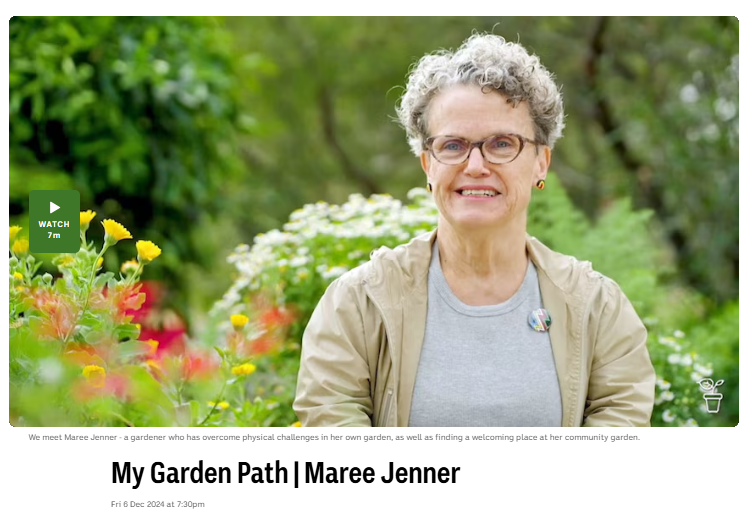
To her surprise, the ABC then invited Maree to be part of a Gardening Australia episode, where she showed viewers around the Peninsula Community Garden of which she is a member, and where she spoke about her inclusion work with Social Futures.
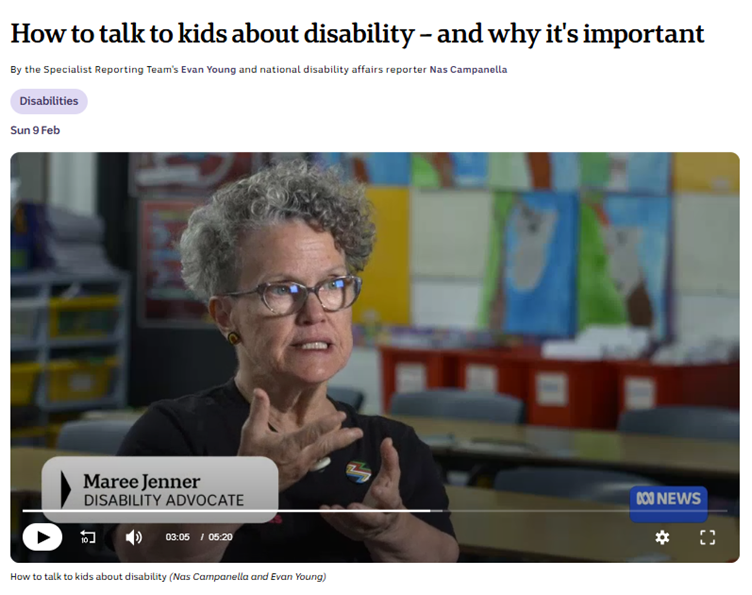
Her next major media appearance came when the Short Statured People of Australia, of which Maree is a member, approached ABC Disability Affairs Reporter, Nas Campanella, to do a story on an upsetting trend appearing on social media. People were being encouraged to photograph those with short stature or dwarfism without their permission and upload them to a Facebook page. Not wanting to sensationalise or further promote such a practice, the story instead focussed on education and allyship. Following this the ABC Producer asked Maree if she would be interested to do a piece on how to talk to children about disability, and Maree spoke about her work with Social Futures, educating children and young people about disability and inclusion.
The Australian Government took notice.
When she received the call inviting her to be one of six national ambassadors, Maree was stunned.
“I was so chuffed,” she shares. “I’ve had a really tough year this year with surgeries… so this was just such a nice, good thing to happen. It was just like, wow, this couldn’t have happened at a better time. It gives me goosebumps.”
Being selected has been especially wonderful for Maree, because of the representation it offers for her specific community.
“I think I’m the first person with short stature to be an ambassador for International Day,” she reflects. “We are a very rare population… so it’s marvellous to see us being represented in this way.”
The most common condition of dwarfism is achondroplasia, which affects approximately 1 in every 20,000 births, according to the Short Statured People of Australia (SSPA). There are approximately 27 million people in Australia today so accordingly, approximately 1,360 Australians live with achondroplasia. Some rarer conditions are 1 in 10 million.
“That’s why you get a surprise when you see me and other people with short stature or dwarfism in the street or going about our activities, because it’s very rare,” Maree said.
Maree was flown to Canberra where she met the five other IDPWD Ambassadors for the first time, and found she was an elder among the group.
“These young people are such good role models, they’re so proud to be out there. Me at that age, I was not like that. I felt that I wasn’t what I needed to be to be proud, because I lived in a world that’s built for average type people. Thankfully that is changing.”
“The young people today, and the adults of tomorrow are the ones that are going to create more of that positive change; they are the architects of the future and they’re so much more inclusive in their thinking.”
Watch Maree’s IDPWD video here: https://www.idpwd.com.au/maree-jenner/
A significant part of Maree’s role at Social Futures involves delivering the ‘Same But Different’, and ‘Champions for Change’ programs in schools on the Central Coast, alongside colleague, Orange-based Community Engagement LAC Prue McCarthy, who created the school inclusion program, ‘Different on the Outside, Same on the Inside’.
Maree believes that engaging with young people is the key to creating long-term societal change. Unlike adults, who can sometimes be judgmental or awkward, children, she says, are simply curious.
“With me, my difference or disability is extremely visible,” Maree explains. “It is about teaching children to be kind and respectful when they meet someone who is different.”
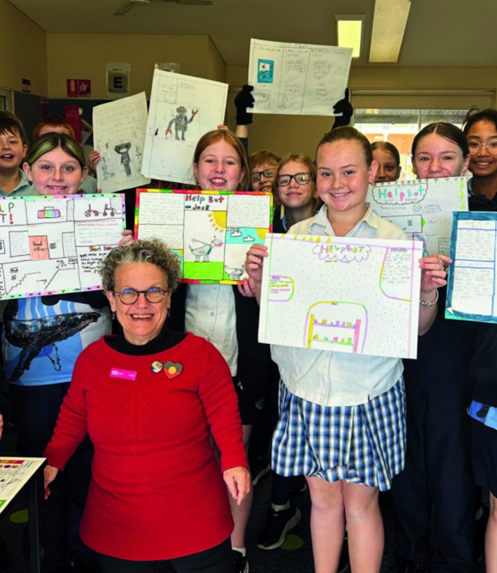
Maree encourages questions and open dialogue, transforming curiosity into understanding.
She tells a story of a young boy she met at a farmers’ market after speaking at his school. His mother told Maree that her son was now “fixed on universal design” and constantly looking for ways to make the world more accessible.
“He looks wherever he goes in the community for things that are inaccessible,” Maree says. “He created the ‘shop bot’ for me to go shopping. This is where the name, ‘Champions for Change’, comes from. I encourage all the young people I speak to, to be champions for change in their communities.”
Maree’s presence in schools does more than educate. For students who live with disability, seeing a proud, confident and successful adult like Maree can be life changing.
She recalls a recent session where she spoke about the Sunflower Lanyard for hidden disabilities. “Two students in the class put their hand up and said, ‘I have Autism.’ So, we talked about that… we are creating a safe place and enabling people to feel comfortable to share their disability or difference.”
Maree also advocates for individual students, like a young girl with a rare form of short stature who is about to start high school. Maree will soon be speaking at her school assembly and with the teaching staff to help smooth the transition.
“If I had had someone like me come to the school [when I was young], I’d have loved it… seeing a child with disability thrive in a supportive school environment… that’s what gives me hope.”
When asked what an inclusive future looks like, Maree doesn’t hesitate before she says, “it’s a world where accessibility is standard, not an afterthought or a special accommodation.”
“The world is not built for me,” she states simply. “An inclusive future is where… accessibility in relation to the built environment is universal. And accommodations in the workplace are standard.”
Getting there requires a shift in attitude and moving from assumption to conversation. Maree emphasises that employers and community members need to ask people with disability what they need, rather than assuming they can’t participate.
“It’s about listening to the person,” she advises. “Instead of assuming, ask the person you are interviewing for a job to tell you how they can do the job, and ask them what accommodations they need… They’ll know.”
It is evident when speaking to Maree, and listening to her stories, that advocacy is hard work, often involving uncomfortable conversations.
Recently, Maree said she lined up at a cash register at a local store but when she went to pay for her items, she could not reach the EFTPOS terminal. A person standing in line behind her asked for Maree’s credit card, in a move she obviously thought would assist, and seemed offended when Maree needed to explain why she should not need to hand her credit card to a stranger to pay for her items. ‘Would you hand your credit card to a stranger?’ she asked the person.
She revisited that same store recently to see that the EFTPOS terminal had been placed in an accessible area for her. It is moments of progress like these which keep Maree motivated.
“It can be exhausting, but the reward is when [you know] it is making positive change,” she says. “Seeing a child with disability thrive… or witnessing a community come together to create a more inclusive event – that’s what gives me hope. It’s the small wins and the collective effort that keep me motivated to continue this important work.”
“If I could hope for one thing, it would be for society to value disability as part of human diversity. Everyone belongs and we all need to be treated with kindness and respect,” she says.
Maree also stresses the importance of being an ally. Whether it’s challenging a stereotype, making a business accessible, or simply having a conversation, everyone has a role to play.
“Inclusion is everyone’s responsibility. Small actions can have a big impact.”
Congratulations on this incredible achievement Maree – we look forward to seeing the continued impact of your voice reach far and wide on a national stage.
Watch or listen to Maree’s Interviews