On 2 June 2026, during National Reconciliation Week, Social Futures officially launched its latest Innovate Reconciliation Action Plan (RAP), covering May 2026 to April 2028. The plan deepens the organisation's commitment to cultural safety, Aboriginal and Torres Strait Islander employment, community partnerships, and self-determination across its growing service footprint.
On 2 June 2026, during National Reconciliation Week, Social Futures officially launched its latest Innovate Reconciliation Action Plan (RAP), covering May 2026 to April 2028. The plan deepens the organisation’s commitment to cultural safety, Aboriginal and Torres Strait Islander employment, community partnerships, and self-determination across its growing service footprint.
This milestone marks more than eight years of sustained reconciliation efforts at Social Futures and signals a clear intention to go deeper, not just broader. The Innovate RAP, which runs from May 2026 to April 2028, builds on what has already been achieved and embeds those learnings more firmly into how Social Futures operates every single day — across its programs, its workplaces, and its relationships with Aboriginal and Torres Strait Islander communities.
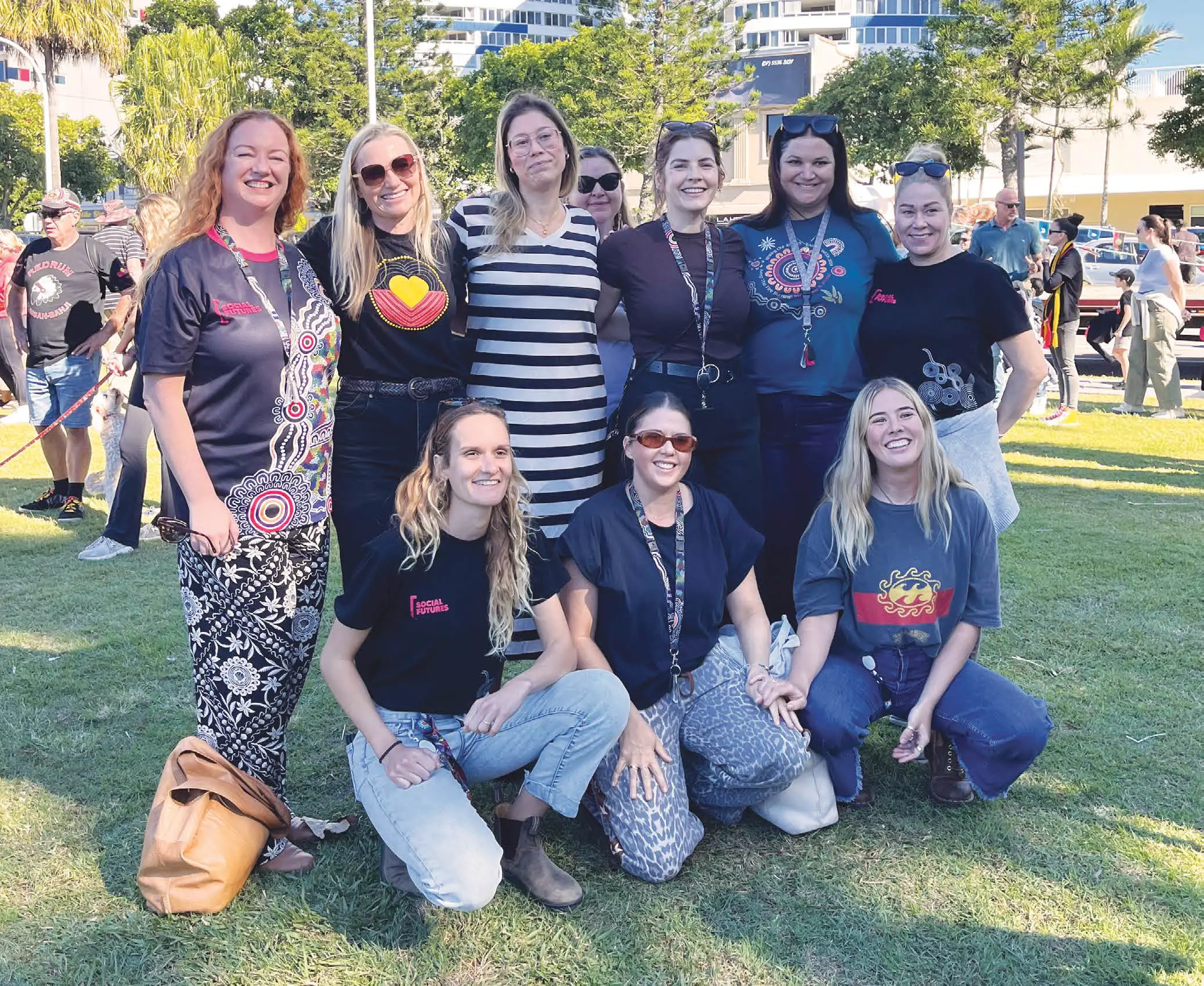
Image: Photo taken by Alex Lally at the 2025 NAIDOC Week March in Tweed Heads
(Top L–R) Brooke Billett, Karen Ford, Nathalia Marins, Vanessa Lyngsted (behind), Kailee Oxenbridge, Stephanie Dickie, Rebekah Graham-Betts (Bottom L–R) Ingrid Neumann, Meryl Alley, Annie Heslin
Here’s what the launch means, what the plan covers, and why it matters.
A Reconciliation Action Plan is a structured framework developed through Reconciliation Australia that helps organisations take meaningful, practical steps toward reconciliation. There are four RAP types — Reflect, Innovate, Stretch, and Elevate — each representing a deepening level of commitment and accountability.
An Innovate RAP is designed for organisations that have already established a foundation for reconciliation and are ready to test and trial new approaches. For Social Futures, this means building on previous achievements and translating its reconciliation vision into more embedded, day-to-day practice across every team and department.
Reaching a fourth RAP is not something every organisation achieves. It reflects a sustained, evolving commitment — one that Social Futures Board and Aboriginal Advisory Panel member Trish Oxford described as a source of genuine pride at the launch event.
“This is Social Futures’ 4th Innovate RAP, which is something that we are all incredibly proud of, and it shows a sustained commitment over time and a willingness to keep learning and improving and strengthening how we work with Aboriginal and Torres Strait Islander peoples.” — Trish Oxford, Social Futures Board and Aboriginal Advisory Panel Member
Trish also noted a meaningful shift in how the organisation engages with communities — one that reflects broader maturation in its approach.
“It’s really clear to see how much Social Futures’ approach to working with and for Aboriginal communities has matured over the years. There’s been a real, definite shift from engagement to genuine partnership, and from activity to more embedded, culturally informed practice.”
For an organisation with a large and growing service footprint, this kind of cultural evolution carries real weight. The work Social Futures does directly impacts communities across a wide geography, making reconciliation not just an organisational value but a practical necessity.
At the launch, Social Futures CEO Tony Davies was clear: reconciliation is not an add-on to the organisation’s work. It sits at the very heart of it.
“Our purpose as an organisation is positive social change, and therefore reconciliation — which is all about positive social change — is a core part of our purpose. It’s because we all want to work for a just, equal, and reconciled Australia where Aboriginal and Torres Strait Islander children have the same life chances and choices, and the same life expectancies, as non-Indigenous children.” — Tony Davies, CEO, Social Futures
Tony reflected on the progress made over the past eight years while making it clear that past achievements are a launching pad, not a resting place.
“By launching a new RAP, it’s about saying we’re not going to rest on our past achievements … We’re trying to go deeper, further translating our vision into real actions that require every one of us to think about how we contribute to reconciliation.”
The RAP asks some direct and challenging questions of the organisation: How do we increase cultural safety? Where and how do we need to improve? Are we creating opportunities in community? How do we use our procurement strategy to advance reconciliation? These are the driving agenda for the next two years.
Georgina Bruinsma, Senior Manager of Aboriginal Leadership and Engagement, led the development process and outlined the key areas of focus for the plan at the launch.
“This RAP defines specific actions and programs of work over the next two years across the pillars of relationships, opportunities, respect, and governance. By intentionally moving forward with our Innovate RAP, we’ve chosen to further embed and strengthen our work across all four streams, as well as across all organisational departments.” — Georgina Bruinsma, Senior Manager Aboriginal Leadership and Engagement
The RAP was developed through meaningful consultation at multiple levels—including with General Managers, RAP Implementation Group, the RAP Working Group, the Aboriginal Advisory Panel, Social Futures Board, the Our Mob group, and the Wujalla Community of Practice. This collaborative foundation ensures the plan reflects genuine community input, not just organisational intent.
A central priority of the new RAP is how Social Futures supports its Aboriginal and Torres Strait Islander staff. This includes building leadership capacity, enhancing cultural safety in the workplace, and expanding the cultural humility learning journey that already underpins how teams operate.
Trish Oxford also spoke to the Board’s strong commitment in this area:
“From a Board perspective, there’s a really strong commitment — and there always has been — to ensure that the RAP is not just implemented but genuinely embedded. This includes supporting Aboriginal and Torres Strait Islander staff through employment, development, and retention, and continuing to build a really culturally safe and supportive workplace.”
The RAP also focuses on how Social Futures shows up in community — building trust, supporting self-determination, and working alongside Aboriginal community-controlled organisations. Georgina described the goal clearly:
“We encourage and support more dialogue, more trust, and more understanding, so that we can be seen as a trusted service — someone alongside Aboriginal and Torres Strait Islander peoples and communities.”
This includes continued work with Working with Mob Plans that are co-designed with communities, ensuring services are guided by community voice rather than external assumptions.
The Wujalla Resource — a cultural humility tool developed to support reflection and learning across teams — continues to play a key role in the organisation’s approach. Alongside this, the RAP includes a strengthened Aboriginal and Torres Strait Islander procurement strategy, using the organisation’s buying power as a lever for reconciliation.
Perhaps the clearest message from the launch was this: reconciliation doesn’t belong to one team or one role. As Tony Davies stated, “Reconciliation is everyone’s business”.
With a growing network of reconciliation champions and allies across the organisation, Social Futures is investing in the people who carry this work forward every day. The RAP team — led by Senior Manager of Aboriginal Leadership and Engagement, Georgina Bruinsma; and Reconciliation and Engagement Officer, Cassie Sheppard — is available to support staff who want to deepen their contribution to reconciliation in their teams and roles.
The fourth Innovate RAP runs through to April 2028. Over that period, Social Futures will report on progress through its RAP Implementation Group and RAP Working Group, with ongoing oversight from the Aboriginal Advisory Panel, Our Mob and the Social Futures Board.
The structure is intentional. As Georgina noted, “We have a strong structure and governance around this RAP that will continue to support our cultural humility learning journey, our Aboriginal employment, retention and development strategy, and support for creating trusting, collaborative, and supportive relationships with Aboriginal community-controlled organisations.”
The launch of our latest Innovate RAP is a significant moment — but it’s the work that follows that will define it. Social Futures has a clear plan, strong governance, and a community of people committed to seeing it through.
Social Futures’ latest Innovate RAP is a two-year action plan (May 2026 to April 2028) that outlines specific commitments across relationships, opportunities, respect, and governance. It builds on the organisation’s previous three RAPs and focuses on deeper embedding of reconciliation into daily practice, cultural safety, and community partnership.
The Innovate RAP was launched on 2 June 2026, during National Reconciliation Week.
An Innovate RAP, developed through Reconciliation Australia, is designed for organisations ready to trial and embed new approaches to reconciliation. It requires specific, measurable actions and strong governance, and is suited to organisations that have already laid a foundation through earlier RAPs.
The RAP was developed through a consultative process involving General Managers, the RAP Implementation Group, the RAP Working Group, the Aboriginal Advisory Panel, the Social Futures board, the Our Mob group and the Wujalla Community of Practice. The Senior Manager of Aboriginal Leadership and Engagement Georgina Bruinsma and Reconciliation and Engagement Officer Cassie Sheppard led the process.
Social Futures supports Aboriginal and Torres Strait Islander staff through dedicated employment, development, and retention strategies, cultural safety initiatives, and leadership capacity building. These commitments are embedded within the fourth Innovate RAP.
Staff can connect with reconciliation champions and allies across the organisation, or reach out directly to the RAP team to explore how to further champion reconciliation in their role and team.